Audio & Wellness · Practical guide
Binaural Beats and Audio Wellness: What the Research Can and Cannot Say
Binaural beats are a listening phenomenon, not a proven shortcut to a different mental state. Here is the mechanism—and where the evidence stops.
A listening experience can be interesting without promising a change in brain performance.
A clear path through the topic
What You’ll Learn
The pattern
Understand the everyday situation and the factors that may shape it.
Practical steps
Review realistic habits and questions you can use without an all-or-nothing plan.
The product context
See where The Genius Song fits, what is confirmed and what still needs verification.
In This Guide
A familiar moment
Does this sound familiar?
- You want a calmer way to begin a task or take a break.
- Different sounds feel helpful on different days.
- Audio product claims seem more certain than the underlying evidence.
If so, take a breath—the useful next step is observation, not a perfect overhaul.
How do sound, context and the activity itself shape the listening experience?
What are binaural beats?
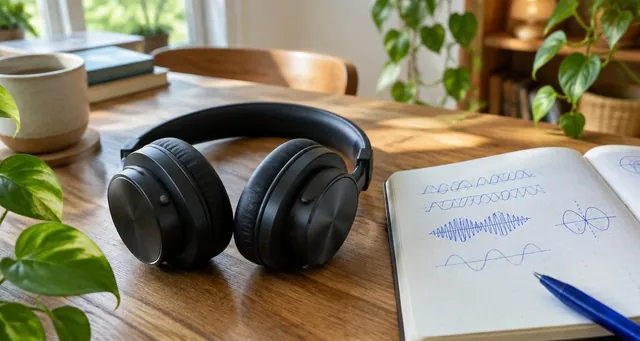
When slightly different pure tones are played separately to each ear through stereo headphones, a listener may perceive a rhythmic beat that is not physically present as a third external sound. This perceived difference is called a binaural beat.
The method depends on each ear receiving a separate signal; ordinary room speakers do not create the same listening arrangement. Volume should remain comfortable. You do not need to use audio at all if it makes you uncomfortable.
The experience is interesting as a feature of hearing. The fact that a beat is perceived does not establish a particular effect on intelligence, learning, mood or sleep.
Why the format attracts interest
A track is easy to play, headphones are common and audio fits into an existing evening or work routine. Online descriptions often pair specific tone differences with desired states such as focus or relaxation.
Those labels can sound precise even when the everyday outcome is uncertain. Interest in a technology is not evidence that millions use it or that a product based on it produces a benefit.
People also listen to ordinary music, nature recordings and silence for similar practical reasons. A structured break or reduced noise may be useful without depending on a binaural mechanism.
Option to explore
A Related Approach Some Readers Are Researching
Our independent guide looks at a related commercial audio program's presentation and consumer questions; we do not claim it uses binaural beats.
What research asks—and what it does not prove
Researchers have studied binaural-beat listening in short controlled settings, including attention and memory tasks. Reviews describe varied methods and mixed findings. Differences in frequency, duration, comparison audio and participants make broad conclusions difficult.
An observation during a brief laboratory task does not show that a commercial recording improves job performance, treats a sleep disorder or changes long-term cognitive health. It does not establish what a specific named program will do for a particular person.
Claims about reliable brainwave entrainment or guaranteed results should be treated with skepticism. Ask what outcome was measured, how it was compared and whether the exact product was studied.
How to make an informed listening choice
If you are curious, first ask what you want from the session: a short break, an enjoyable listening experience or a quieter transition to a task. Try a comfortable track without expecting a medical or cognitive result.
Compare how you feel with another reasonable option, such as gentle music or silence. Avoid driving or safety-sensitive work while deeply absorbed in an audio experiment. If a sound causes discomfort, stop listening.
Persistent sleep, mood or attention concerns warrant individualized professional guidance. Audio wellness is not a substitute for diagnosis or treatment.
Curiosity: a perceived beat is not a hidden signal
The beat is an auditory perception produced by presenting two tones separately—not proof that an audio file secretly directs behavior. This distinction matters when marketing jumps from a genuine perceptual effect to a much larger promise.
Being interested in sound science and being skeptical of a sales claim are compatible. You can appreciate the phenomenon without purchasing anything or treating a playlist as therapy.
Questions to ask about an audio program
A digital listening product may offer structure and a repeatable ritual. If you encounter The Genius Song, our independent guide summarizes its seller presentation and explains which claims and purchase terms require careful review.
Do not assume the program uses binaural beats just because an article about audio links to it. Confirm the actual format with the seller, and separate the research discussed here from claims about that particular product.
A low-pressure next step
What to notice next
- Choose a real activity or break to pair with listening.
- Notice whether the sound helps or distracts in that setting.
- Separate general audio research from claims about a particular product.
Frequently Asked Questions
Do binaural beats require headphones?
The classic setup presents different tones separately to each ear, so stereo headphones are generally used.
Do binaural beats guarantee better focus or sleep?
No. Results in research are mixed, and no listening track can guarantee an individual outcome.
Is The Genius Song proven to use binaural beats?
This article does not establish its technical format. Verify what the seller provides; the research here is not evidence for the product.
Keep the science and the sales pitch separate
A perceived beat is real as a listening experience. Its existence does not prove a commercial promise. Enjoy sound at a safe volume and evaluate every offer on its own terms.
Further reading
Public-health resources for additional context. These links do not imply an endorsement of any product discussed here.